EagleVision Productions, Inc.
Road to Liberty Educational Project
with Teacher’s Guides
Produced by EagleVision Productions, Inc. (EVP), the Road to Liberty Educational Project is an educational companion to EVPs documentary, Road to Liberty Through Their Eyes, that NETA is distributing to public television stations nationwide.

The educational project consists of ten Educational Webisodes with Teacher’s Guides, authored by Joseph “Joe” Refinski, a retired history teacher. During his 48-year tenure, Joe won numerous teaching awards, recognitions and Fellowships, including several Teacher of the Year Awards and the New Jersey Council for the Social Studies 2025 Lifetime Educator Award.
The Ten Educational Webisodes with Teacher’s Guides expand on some of the topics addressed in Road to Liberty Through Their Eyes, as well as additional topics not covered in the documentary.
Road to Liberty Educational Project with Teacher’s Guides
Integrated Continental Army
Webisode 1 focuses on free and enslaved Blacks as well as Native Americans who were integrated into both the Crown’s Ministerial Army and the Continental Army and state militias during the American Revolution and covers the choices they made and why they made them.
Running Time: 8:23
Webisode 2
Fortifications
One of the duties of the enlisted soldiers was to build fortifications. We will expand on the extensive fortifications built to protect New York City that Congress ordered Washington to protect at all costs, which turned out to be an impossible undertaking against the might of the British Royal Navy and Ministerial Army.
Running Time: 6:49
Webisode 3
Divided Country
When hostilities erupted between the Patriots and the Crown’s Ministerial Army, other colonists wanted to remain loyal to the King, creating fractured families and communities as violence increased exponentially between the Patriots and Loyalists, which some historians have called America’s first civil war.
Running Time: 7:41
Webisode 4
Militias vs Standing Army
Due to the Redcoats occupying Boston, many colonists considered standing armies a threat to their freedom, and preferred militias made up of civilians to defend their communities. However, General George Washington was appalled at the lack of discipline and short enlistments and informed Congress that he couldn’t rely on militias to win the war.
Running Time: 7:02
Webisode 5
Camp Followers
The role of camp followers is not an easy one, especially for women. But like all armies, the Continental Army relied on women to provide essential services, like laundering and nursing; as well as artificers – skilled trades people – like blacksmiths and wheelwrights, and peddlers, known as sutlers, who followed the army to supply it with services and goods.
Running Time: 6:30
Webisode 6
Impact of War
This webisode examines the impact that the revolutionary war had on a variety of socioeconomic groups, including Patriot and Loyalist civilians, women and children, free and enslaved Blacks, and Native Americans that created incredible hardships on everyone.
Running Time: 8:10
Webisode 7
Spies and Informants
General George Washington believed intelligence was a critical element an army needed to keep one step ahead of the enemy and began to build a network of reliable and trustworthy spies in spite of setbacks like receiving misinformation from double agents.
Running Time: 5:50
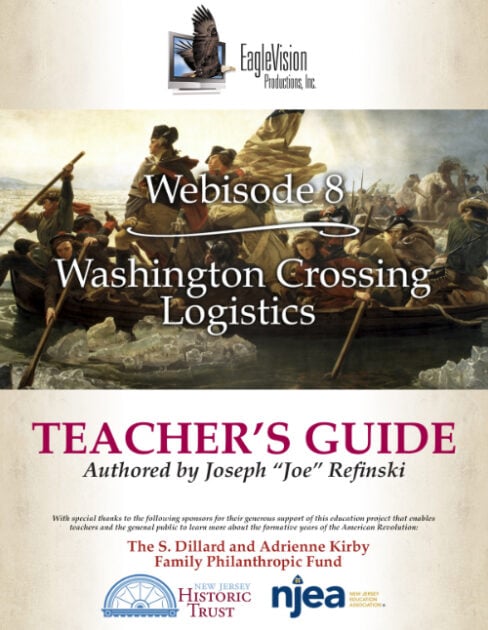
Webisode 8
Washington Crossing Logistics
This webisode looks into the logistics that went into the Christmas Night Crossing in a Nor’easter and snowstorm, followed by a 9-mile March on Trenton with eighteen cannon. The watchword for the night of the crossing was “Victory of Death.”
Running Time: 6:06
Webisode 9
Winter Encampment / Forage Wars
The Forage Wars are rarely discussed in history classes, but during the winter and spring of 1777, Washington deployed his troops and militias in the Watchung Mountains to attack British foraging parties, inflicting heavy casualties and preventing them from gaining access to food and supplies to take back to their garrisons located in North and East Jersey.
Running Time: 5:09
Webisode 10
Living History / Reenactments
Many NJ and PA historic sites hold annual American Revolution that commemorate the battles for independence that took place on these sites, and reenactors explain why they’ve joined a regiment and participate in these events because they believe it’s important to keep history alive and pass it on to a new generation.
Running Time: 7:02
Road to Liberty Educational Project Credits
Executive Producers: Janice Selinger, Jill A. Hargrave
Producer/Writer/Researcher: Jill A. Hargrave
Narrator: Ian Kahn
Editor: Paul Waide, Apex Productions 
Lead Camera: Steve Stone
Graphics Designers: Steve Oleszek, Charlie Starkey
Composer: Ben Morris
Historical Musicians: Linda Russell, NJ Fife and Drums
Webmaster: Tor Jones, Jones & Jones Advertising, Inc.
Special Thanks to all the Artists, Reenactment Photographers, and Filmmakers listed on the Road to Liberty Documentary and to all the Regiments, Reenactors, Historians, and Historical Experts. who contributed to this documentary and educational project. Additional thanks to the New Jersey Council for the Social Studies who provided input regarding the content of the Ten Educational Webisodes and Teacher’s Guides.
This educational project is made possible by the generous support of: